zaki-ns CMS Architecture Lab
ActifDémarré octobre 2025· Mis à jour juin 2026

zaki-ns CMS Architecture Lab

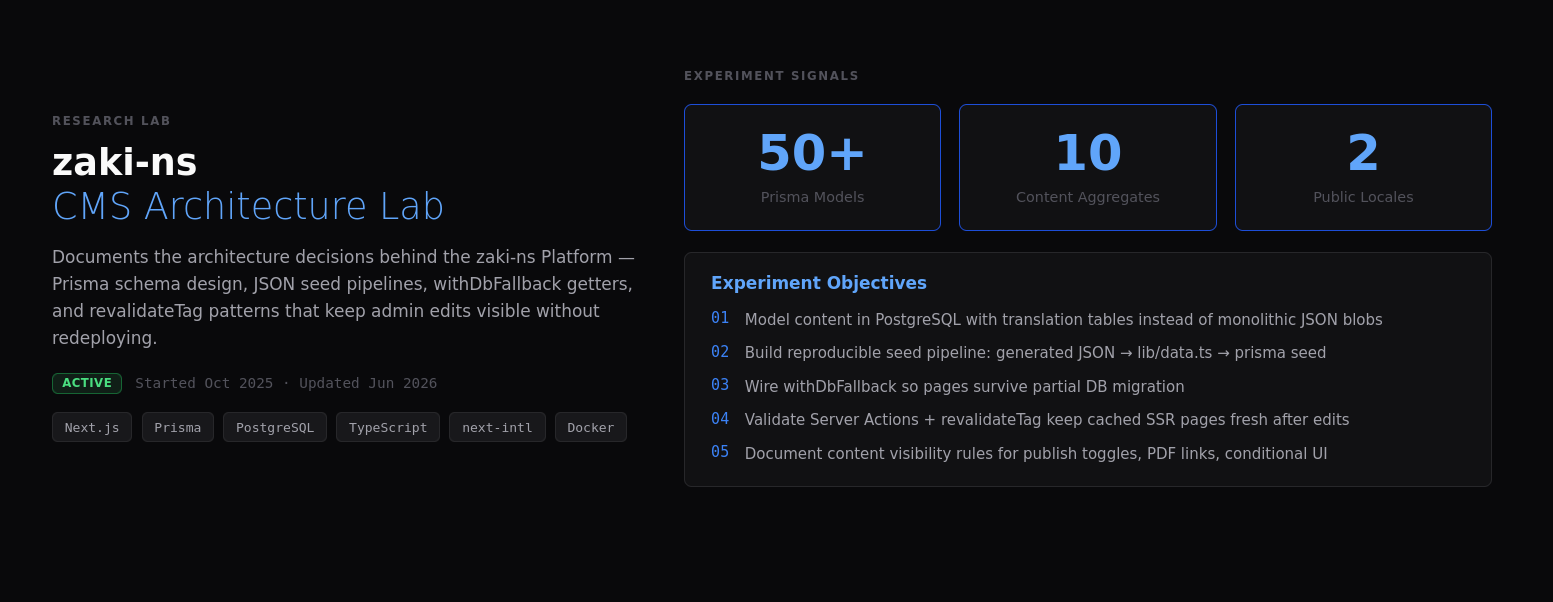
This lab documents the architecture decisions behind the zaki-ns Platform—Prisma schema design, JSON seed pipelines, withDbFallback getters, and revalidateTag patterns that keep admin edits visible on the public site without redeploying.

Signaux d'expérience

Prisma models
50+
Content aggregates
10
Public locales
2
Next.jsPrismaPostgreSQLTypeScriptnext-intlDocker
Brief de recherche

Objectifs de l'expérience

  1. 1Model portfolio content in PostgreSQL with translation tables instead of monolithic JSON blobs
  2. 2Build a reproducible seed pipeline from generated JSON through lib/data.ts into prisma db seed
  3. 3Wire public getters with withDbFallback so pages survive partial DB migration
  4. 4Validate admin Server Actions + revalidateTag keep cached SSR pages fresh after edits
  5. 5Document content visibility rules for publish toggles, PDF links, and conditional UI sections

Apprentissages clés

  • Translation tables with @unique([entityId, locale]) scale better than duplicating entire entities per language
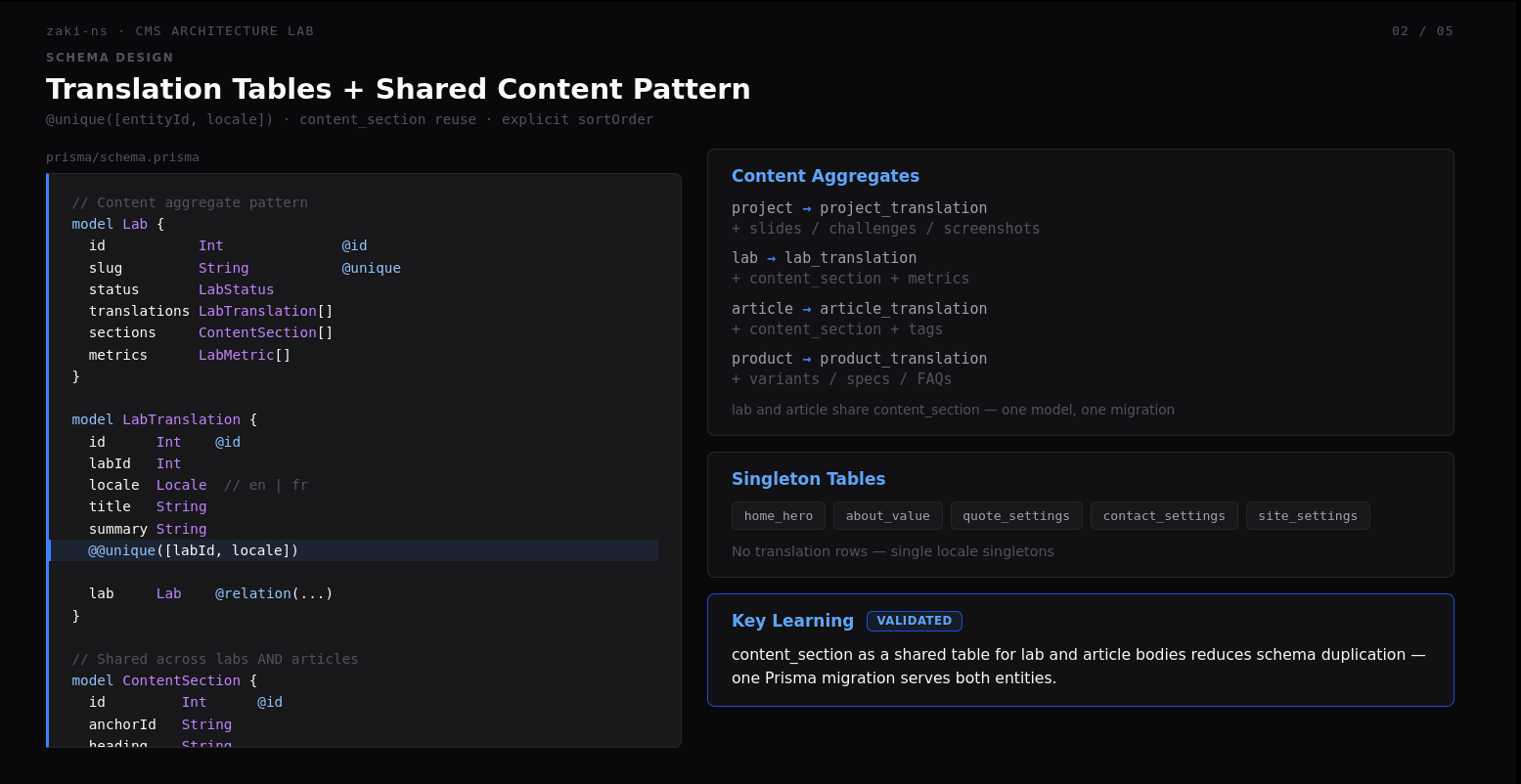
  • content_section as a shared table for lab and article bodies reduces schema duplication
  • Granular cache tags (projects, labs, articles) beat full-site revalidation after admin saves
  • Domain types in lib/ decouple React components from Prisma—mappers absorb schema changes
  • Version-controlled generated JSON makes demo portfolios reviewable and diffable in PRs

Visuels du labo

zaki-ns CMS Architecture Lab — 2
1 / 4

Journal d'expérience

Étapes documentées, notes d'architecture et résultats du processus de recherche.

Lab Overview

This lab is the architectural companion to the zaki-ns Platform project. Instead of treating the portfolio as static pages, we treat it as a small CMS: normalized tables, admin CRUD, cached reads, and structured long-form content for labs and articles.

The goal is a codebase you can deploy once per customer with admin-editable content and zero mock-data drift between seed, admin, and public pages.

Schema Design

Content aggregates—project, lab, article, product—each have a core row plus translation rows for locale-specific text. Nested relations (slides, challenges, metrics, sections) hang off the aggregate with explicit sortOrder columns.

Labs and articles share a content_section pattern: anchorId, heading, paragraphs[], optional list[], optional code block.

  • project + project_translation + slides/challenges/screenshots
  • lab + lab_translation + content_section + metrics
  • article + article_translation + content_section + tags
  • Singleton site tables: home_hero, about_value, quote_settings

Seed Pipeline

Content is authored in generated/generate-portfolio-content.py, exported to generated-portfolio-content.json, imported by lib/data.ts, and loaded into PostgreSQL via prisma/seed/content.ts.

This pipeline keeps demo data rich (case studies, labs, articles) while remaining reproducible: npm run db:reset restores the full showcase.

snippet
# Regenerate content JSON
python generated/generate-portfolio-content.py

# Reseed database
cd new && npm run db:seed

Cache Invalidation

Public getters wrap Prisma queries in unstable_cache with entity-specific tags. Admin Server Actions call revalidateTag after successful writes so the next SSR request fetches fresh data.

During migration, withDbFallback catches DB errors and serves lib/data.ts until seed counts verify.

Active Experiments

Current work explores schema-driven admin forms that auto-sync when Prisma models change, and moving quote calculator constants from lib/quote-data.ts into quote_settings rows for full CMS coverage.